Las Vegas Car Accident Guide: Medical Care, Evidence, and Insurance Steps
Key Takeaways
- Safety and medical care should take priority over gathering information after a crash.
- Photographs, witness details, medical documents, and a written timeline can preserve important facts.
- Insurance discussions should remain accurate, brief, and limited to known information.
- Symptoms can develop after the initial shock of a collision, so changes should be documented.
- Organized records can help a personal injury representative assess a claim more effectively.
A serious collision can change a person’s day, health, income, and plans in a matter of seconds. After receiving necessary medical attention, injured people in Las Vegas may consider speaking with a Nevada personal injury legal team to understand better the claims process, which records may matter, and the questions they should ask before making major decisions.
Personal injury legal representation is not only about a lawsuit. It can involve organizing evidence, communicating with insurance companies, evaluating losses, and helping an injured person focus on treatment and recovery. Every situation is different, so the most useful first step is often to preserve calm and a qualified provider or settlements.
Why the First Few Hours Matter
Crash scenes change quickly. Vehicles are moved, debris is cleared, traffic signals change, and witnesses leave. A driver may remember the general impact but later struggle to recall which lane each vehicle occupied, where the collision occurred, or what the traffic light showed. Early actions should focus on safety and factual documentation, not on debating fault at the roadside.
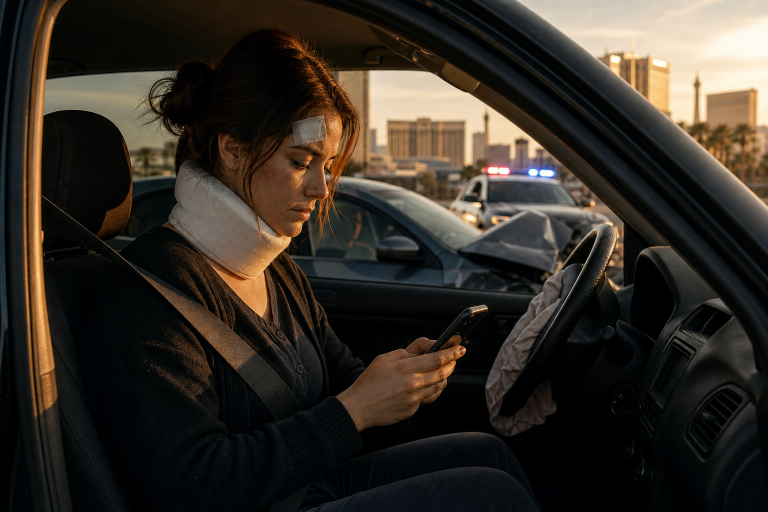
It is also important to remember that pain may not be immediately obvious. Stress and adrenaline can mask symptoms, particularly after impacts involving the head, neck, back, chest, or joints. A prompt medical evaluation creates a record of concerns and gives a qualified provider the opportunity to identify injuries that may need treatment.
Get to a Safe Place and Seek Medical Care
Immediately after a collision, check for urgent dangers such as moving traffic, leaking fluid, smoke, or fire. Call 911 when someone may be injured, or the roadway is unsafe. If the vehicles can be moved safely and there are no injuries, move out of traffic when appropriate. Turn on hazard lights and avoid standing in active lanes to take photos or exchange details.
Medical attention is especially important for dizziness, confusion, headaches, neck pain, numbness, weakness, chest pain, trouble breathing, or severe swelling. Follow discharge instructions, attend recommended appointments, and save records of prescriptions, imaging, therapy, bills, and transportation to appointments. These documents can help show both the medical course of treatment and the practical effects of an injury.
Report the Collision and Preserve the Basics
An official report can be useful when accounts of a crash differ. Record the responding agency, officer’s name, report number, and instructions for requesting a copy. Drivers should also understand that Nevada crash-reporting requirements may apply even when an officer does not investigate the collision.
When exchanging information, keep the conversation calm and factual. Collect the other driver’s full name, contact information, insurance details, license information, vehicle description, and plate number. If passengers or witnesses saw the crash, ask for their names and reliable contact information. Avoid guessing about speed, distance, fault, or the seriousness of injuries.
Photograph the Scene Without Creating Another Risk
If it is safe, take photographs in layers. Start with wide photos showing the roadway, intersection, lane markings, traffic lights, signs, weather, and nearby businesses. Then take medium-distance images of vehicle positions, debris, skid marks, and road conditions. Finally, capture close photos of impact damage, paint transfer, broken parts, deployed airbags, seat belt marks, and visible injuries.
Save original files instead of editing or compressing them. Follow-up photographs can also be valuable if bruising, swelling, or other visible symptoms appear later. Never enter traffic or ignore instructions from emergency personnel to obtain a better image.
Preserve Digital and Physical Evidence
Evidence is not limited to photographs. Save dash camera footage before it is overwritten, along with navigation records, rideshare receipts, phone screenshots, repair estimates, towing invoices, and appointment confirmations. Write down the names and locations of businesses that may have exterior cameras, since recordings may not be retained for long.
Damaged clothing, helmets, bicycle parts, child safety seats, and vehicle components may also help explain the force or mechanics of an impact. Investigators often examine crash investigation sampling methods that document vehicle damage, scene evidence, struck objects, and other data when studying how a crash occurred. Do not discard potentially relevant items until you understand whether they should be preserved.
Maintain an Injury and Expense Log
A short daily log can provide a clearer picture of recovery than memory alone. Each entry can include the date, pain level, and location, sleep disruptions, headaches, mobility limits, missed work, and activities that became difficult. A factual note, such as “shoulder pain prevented lifting grocery bags,” is more useful than a vague statement that the day was hard.
Keep copies of medical bills, pharmacy costs, mileage to appointments, home-care expenses, repair records, and proof of missed work or reduced hours. This information may help demonstrate losses that are easy to overlook during a stressful recovery period.
Handle Insurance Communications Carefully
Reporting a collision to an insurer is usually necessary, but the first conversation does not require a person to have all the answers. Provide basic facts honestly, identify the vehicles involved, and request the claim number and adjuster’s contact information. Avoid speculating about fault or describing an injury as minor before the full medical picture is known.
Keep copies of emails, letters, forms, and voicemail messages. Before agreeing to a recorded statement, signing a broad medical authorization, or accepting a quick payment, an injured person may benefit from understanding what information is being requested and whether the proposed resolution accounts for ongoing care and lost income.
When Legal Representation May Be Especially Helpful
Personal injury representation may be particularly valuable when injuries are significant, responsibility is disputed, multiple vehicles are involved, or an insurer challenges medical treatment. It can also be helpful in hit-and-run, rideshare, pedestrian, bicycle, motorcycle, commercial-vehicle, and wrongful-death matters. These situations can involve multiple insurance policies, unfamiliar evidence, and competing accounts of what happened.
A lawyer can review available records, identify missing information, communicate with insurers, and explain available options. That does not guarantee a particular result, but it can give an injured person a more organized approach to a complicated process.
Common Mistakes to Avoid
- Leaving the scene without taking the necessary reporting steps.
- Ignoring symptoms or delaying medical care despite worsening pain.
- Deleting photographs, messages, dash camera footage, or app records.
- Posting opinions, admissions, or injury updates on social media.
- Throwing away damaged property that may be relevant evidence.
- Accepting a settlement before treatment needs are understood.
Conclusion
After a Las Vegas crash, the clearest path is often the simplest: get safe, seek medical care, report the incident, preserve evidence, and keep organized records. Careful documentation cannot undo an injury, but it can create a stronger factual foundation for insurance discussions and any decision to seek personal injury legal representation.