The Gemological Masterclass: Moissanite vs. Diamond – Hardness, Optics, and Modern Lapidary Science
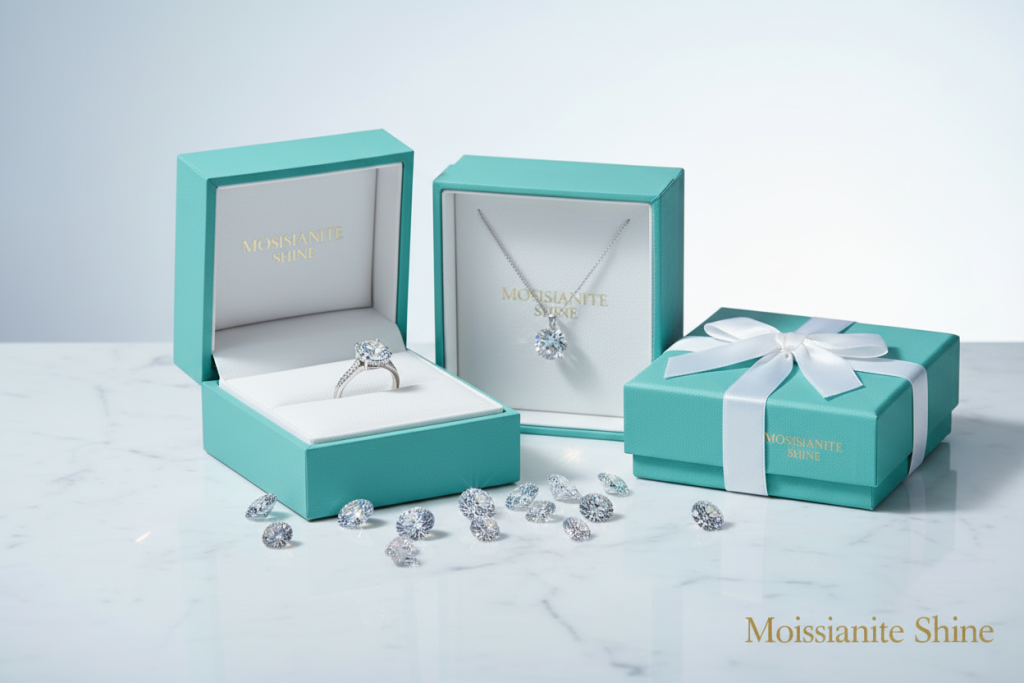
In the expanding field of modern gemology, few materials have ignited as much scientific interest and market transformation as moissanite. Long evaluated through the narrow lens of diamond simulation, silicon carbide (moissanite) has earned recognition as an exceptional gemstone in its own right. With optical performance metrics that exceed mined diamonds in both brilliance and spectral dispersion, moissanite represents a triumph of advanced crystallography and modern lapidary engineering.
For gem enthusiasts, lapidaries, and conscious jewelry consumers, understanding the distinctions between natural diamond and lab-grown moissanite requires a deep dive into physical properties, light-refraction behavior, and material durability. This comprehensive comparative analysis explores the physical and optical properties that make moissanite an extraordinary stone for daily wear.
GEMOLOGICAL OPTICAL METRICS
| PROPERTY | NATURAL DIAMOND(C) | SILICON CARBIDE(Moissanite / SiC) |
| Chemical Formula | Pure Carbon | Silicon Carbide |
| Refractive Index | 2.417 | 2.651 – 2.691 |
| Dispersion (Fire) | 0.044 | 0.104 |
| Mohs Hardness | 10.0 | 9.25 |
| Optical Character | Isotropic | Anisotropic (DR) |
| Specific Gravity | 3.52 | 3.22 |
Chemical Structure and Crystallographic Origins
To evaluate moissanite correctly, one must first trace its extraterrestrial discovery. First identified in 1893 by French chemist Dr. Henri Moissan inside a meteorite crater in Canyon Diablo, Arizona, natural silicon carbide is exceedingly rare on Earth. Natural deposits exist only in tiny quantities within upper-mantle rocks and kimberlites.
While diamond consists of pure carbon arranged in a face-centered cubic lattice, moissanite is composed of equal parts silicon and carbon covalently bound in a hexagonal polytype crystal structure (most commonly 6H-SiC in gem-grade material).
Because naturally occurring gem-quality moissanite crystals are too small for commercial jewelry, scientists developed advanced thermal-synthesis techniques to recreate the immense heat and pressure of space collision environments. The result is stoichiometric silicon carbide of extraordinary optical purity, graded at colorless D-E-F levels with VVS1 clarity. Today, leading jewelry houses like the master gemologists at Moissanite Shine harness these advanced growing techniques to craft stones with pristine clarity and structural integrity.
Optical Physics: Refractive Index and Dispersion Dynamics
The visual identity of any gemstone is determined by how light travels through its crystalline lattice. Two primary optical parameters govern this performance: Refractive Index (RI), which dictates brilliance (white light return), and Dispersion, which governs “fire” (spectral color separation).
DISPERSION (FIRE) RATIO
| Diamond (0.044) | ████████ |
| Moissanite (0.104 | █████████████████████ (2.3x Higher) |
1. Refractive Index (Brilliance)
Diamond has long been celebrated for its high refractive index of 2.417. However, silicon carbide boasts a significantly higher refractive index ranging between 2.651 and 2.691. When ambient light enters a brilliantly faceted moissanite, light slows down and bends at a sharper angle, causing a dramatically higher percentage of light rays to bounce internally and return directly to the observer’s eye as brilliant white flash.
2. Dispersion (Fire and Spectral Rainbows)
Dispersion measures a gemstone’s ability to separate white light into its component spectral colors—red, orange, yellow, green, blue, and violet. The dispersion rating of diamond is 0.044. Moissanite possesses a dispersion rating of 0.104—more than double that of a diamond. Under sunlight or spotlighting, moissanite exhibits fiery flashes of color, creating a distinctive optical signature celebrated by collectors worldwide.
3. Birefringence (Double Refraction)
Crystalline structures are either singly refractive (isotropic) or doubly refractive (anisotropic). Diamonds belong to the isometric crystal system and are singly refractive. Moissanite is hexagonal and doubly refractive, meaning light rays split into two distinct rays as they travel through the crystal lattice. Modern master lapidaries precisely align the optic axis (c-axis) perpendicular to the table facet, ensuring the double refraction remains virtually invisible to the naked eye while magnifying the stone’s optical depth.
Hardness, Toughness, and Wearability Metrics
For a gemstone to be suitable for daily heirloom wear, physical resistance to mechanical force and surface scratching is mandatory.
- Mohs Scale Hardness: Diamond ranks at 10.0, representing the maximum mineral hardness on Earth. Moissanite scores 9.25 on the Mohs scale, placing it higher than rubies, sapphires (9.0), or emeralds (7.5–8.0). It comfortably resists surface scratches from quartz dust, metals, and daily environmental contact.
- Toughness (Resistance to Chipping): Hardness measures scratch resistance, whereas toughness measures resistance to fracturing upon impact. Thanks to its covalent silicon-carbon bonding, moissanite exhibits exceptional toughness. It lacks the directional cleavage planes found in natural diamonds, making it less susceptible to cleavage fractures when struck at sharp angles.
- Thermal Resistance: Moissanite can withstand extreme temperatures up to 1,100°C (2,000°F) without losing its luster, changing color, or fracturing. This makes it exceptionally safe during routine bench repair, re-sizing, and thermal torch work by goldsmiths.
| MOHS HARDNESS COMPARISON | |
| Diamond | ██████████████████████████████ 10.0 |
| Moissanite | ████████████████████████████ 9.25 |
| Sapphire / Ruby | █████████████████████████ 9.0 |
| Emerald / Topaz | ████████████████████ 8.0 |
Lapidary Precision and Faceting Geometry
Because moissanite’s optical properties differ from diamond, applying standard diamond cut angles to silicon carbide yields suboptimal light reflection. Lapidaries must customize crown angles, pavilion angles, and culet proportions specifically for SiC crystals to optimize brilliance without creating excessive rainbow flash.
When searching for fine jewelry—particularly heirloom-quality precision-cut moissanite engagement rings—buyers should look for tailored cutting proportions. Cushion, round brilliant, oval, and emerald cuts require specific facet symmetry to balance high refraction with crystal clarity, ensuring an impressive visual presence in platinum or gold mountings.
Ethical and Environmental Considerations
In addition to its physical superiority, laboratory-synthesized moissanite addresses pressing ethical and ecological concerns associated with mined gemstones.
- Zero Mining Footprint: Traditional diamond extraction requires excavating hundreds of tons of earth per carat, causing habitat destruction and heavy soil erosion. Moissanite production occurs in controlled laboratory environments with zero land disruption.
- Water and Carbon Offsetting: Thermal synthesis utilizes closed-loop energy systems, consuming significantly less water and producing a fraction of the greenhouse gas emissions associated with industrial mining operations.
- 100% Conflict-Free Supply Chain: Every moissanite gemstone is fully traceable from synthesis through final polishing, guaranteeing a completely ethical origin free from human rights concerns.
Conclusion: The Gemstone of the Modern Era
Moissanite is no longer viewed merely as an alternative to diamond; it is recognized as an extraordinary mineral triumph. Combining a 9.25 Mohs hardness rating with superior brilliance and dispersion, silicon carbide offers a durable, ethically sound, and optically stunning option for fine jewelry. As gemological science advances, moissanite stands out as a preferred choice for connoisseurs who value both technical excellence and sustainable luxury.