From Carbon Precursors to High-Performance Materials: A Practical Guide
Key Takeaways
- Choose carbon precursors based on the finished application’s requirements, not price alone.
- Molecular structure, purity, thermal behavior, and carbon yield strongly influence final material performance.
- Match the precursor and processing route to products such as carbon fiber, graphite, foam, composites, electrodes, or coatings.
- Check softening point, viscosity, mesophase content, carbon yield, ash, moisture, and trace metals before production.
- Use pilot testing and quality control to identify defects and processing problems early.
- Consider supplier consistency, availability, storage, lead times, and scale-up risks alongside technical performance.
- Renewable and alternative feedstocks can expand supply options but must provide reliable chemistry and processing.
- A successful precursor strategy balances performance, processability, cost, quality, and long-term supply reliability.
Carbon-rich precursors are the starting point for advanced materials that must handle extreme heat, transfer electricity, reduce weight, or maintain stability under demanding conditions. The path from raw feedstock to finished carbon fiber, graphite, foam, coating, or composite is not automatic. Molecular structure, impurity levels, thermal behavior, and processing control all shape the result. Selection decisions are increasingly informed by mesophase pitch supplier developments, particularly when manufacturers need a precursor with predictable softening behavior, high carbon yield, and a structure suited to alignment. The best choice is not simply the cleanest or least expensive material. It is the material that performs reliably across the entire production chain.
Why Carbon Precursors Matter
A carbon precursor is a carbon-rich starting material that can be shaped and converted through heat, pressure, oxidation, or chemical treatment into a more functional carbon product. Its chemistry influences final strength, density, conductivity, porosity, thermal expansion, and resistance to degradation. A precursor that works well for a porous carbon foam may be unsuitable for a continuous high-modulus fiber. The connection is straightforward: molecular arrangement affects how a material flows, aligns, shrinks, and releases non-carbon elements during heating. Ordered aromatic structures can support graphitic alignment, whereas less-ordered structures may be better suited to binders, impregnating pitches, or porous products. Recent work to scale materials for graphite and carbon fiber also highlights the importance of turning promising laboratory behavior into repeatable pilot-scale manufacturing.
Common Types Of Carbon Precursors
Most carbon precursor programs begin with one of several material families. Each can be refined or modified to target a particular balance of cost, processability, and finished performance.
- Petroleum-derived materials: Often valued for established industrial supply chains and relatively consistent chemistry after refining.
- Coal-derived materials: Typically rich in aromatic compounds and widely used in pitches, binders, electrodes, and specialty carbon processing.
- Naphthalene-based materials: Offer more controlled molecular building blocks that can support consistent mesophase development and processing.
- Polymer-based precursors: Polyacrylonitrile is widely used for carbon fiber, while pitch routes can be attractive when high modulus or thermal conductivity is important.
- Biomass-derived precursors: Lignin, agricultural residues, and other renewable sources are gaining attention, but variability remains a central scale-up challenge.
How Processing Changes Material Performance
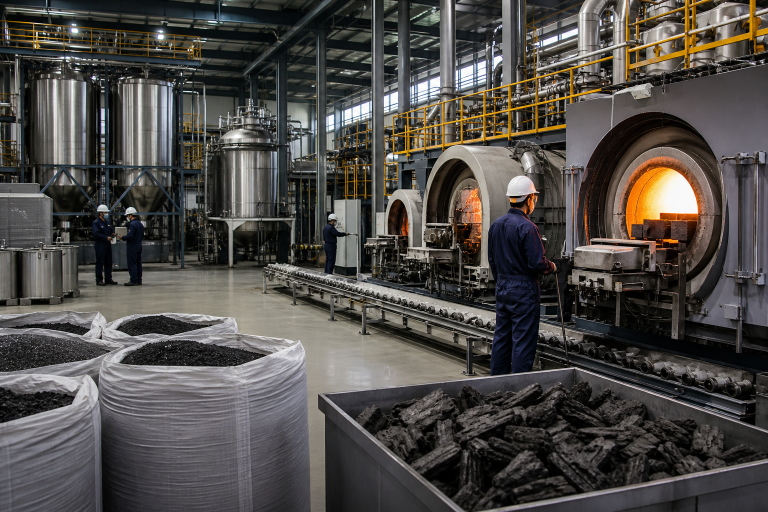
Quality can be gained or lost at every stage of conversion. Feedstock preparation removes moisture, solids, and contaminants that could disrupt flow or create defects. Thermal treatment then encourages molecular rearrangement and raises the carbon concentration.
- Mesophase development: In suitable pitches, liquid-crystal regions form and can provide a foundation for later structural alignment.
- Shaping: Melt spinning, molding, impregnation, coating, and foaming give the precursor its intended geometry.
- Stabilization: Controlled oxidation or another treatment helps the shaped material retain form during subsequent heating.
- Carbonization: High temperatures remove hydrogen, oxygen, nitrogen, and other non-carbon elements.
- Graphitization and finishing: Additional heat can increase crystalline order, followed by sizing, machining, surface treatment, and inspection.
For fiber production, alignment during spinning and heat treatment is especially important. The resulting carbon fiber structure can deliver a highly useful combination of low weight, stiffness, and strength when processing minimizes defects and maintains orientation.
Matching Precursors To Applications
- Carbon fiber: Prioritize spinnability, stable viscosity, molecular orientation, tensile properties, and surface quality.
- Carbon foam: Focus on controlled foaming, pore size, density, stiffness, and directional thermal transport.
- Carbon-carbon composites: Evaluate infiltration behavior, shrinkage, bonding, oxidation resistance, and dimensional stability.
- Thermal management components: Look for graphitic order, high directional conductivity, and low thermal expansion.
- Battery electrodes: Consider surface area, pore architecture, electrical conductivity, and compatibility with binders and electrolytes.
- Coatings and binders: Require appropriate softening point, flow, adhesion, and low levels of harmful contamination.
Key Properties To Check Before Production
A certificate of analysis is useful, but teams should interpret it against the actual processing route. A practical pre-production checklist includes:
- Softening point and the usable processing window.
- Viscosity at the intended spinning, molding, or impregnation temperature.
- Mesophase content and optical texture, where alignment matters.
- Coking value or carbon yield, plus expected shrinkage.
- Ash, trace-metal, moisture, volatile, and quinoline-insoluble content.
- Particle size, physical form, storage stability, and safe handling requirements.
- Batch-to-batch consistency and supplier controls for allowable variation.
Quality Control And Testing
Supplier specifications should support, not replace, application testing. Thermal analysis can reveal softening, mass loss, and decomposition behavior. Polarized-light microscopy can show anisotropic texture and mesophase development. Elemental analysis and ash testing identify chemistry and inorganic residue, while viscosity testing confirms flow behavior under realistic conditions. After carbonization, microscopy and spectroscopy help verify structure, defects, and graphitic development. Small pilot batches are essential before full production because they reveal fiber breaks, unstable foaming, excessive shrinkage, poor impregnation, or equipment fouling before these issues become costly.
Sustainability, Supply, And Scale
Laboratory performance is only one part of a viable precursor strategy. Manufacturers should assess local and imported supply, lead times, storage needs, shipping risk, and the ability to maintain specifications as volumes increase. Industrial byproducts and renewable feedstocks can broaden supply options, but only when their chemistry can be controlled reliably. A low purchase price can lead to a higher total cost if it results in poor yield, additional purification, slower throughput, or inconsistent output. Scale-up also changes heat transfer, residence time, contamination risk, and process repeatability. A successful program defines acceptable feedstock variation before expanding production capacity.
Common Selection Mistakes
- Choosing on price alone instead of evaluating total conversion cost and yield.
- Ignoring the processing window required for spinning, molding, foaming, or impregnation.
- Overlooking ash and trace metals that can affect properties and equipment life.
- Skipping pilot trials before committing to production-scale equipment.
- Using one precursor specification for products with very different performance requirements.
- Failing to plan for supply variation, alternate sources, and qualification limits.
Common Questions
Is A Higher Carbon Yield Always Better?
No. High carbon yield can improve efficiency and reduce shrinkage, but it does not guarantee the needed strength, conductivity, porosity, or ease of processing.
Can Renewable Feedstocks Replace Conventional Sources?
They can become useful alternatives for selected applications, especially when waste reduction and supply diversification matter. However, they must still deliver consistent chemistry, stable processing, and an economically practical yield.
What Is The Best Precursor For Carbon Fiber?
The answer depends on the required modulus, tensile strength, thermal conductivity, cost target, spinning method, and production scale. The right choice is the one that consistently meets those combined requirements.
Conclusion
The strongest carbon-material strategy begins with the finished application and then works backward through material selection, processing, quality control, and supply planning. Instead of optimizing a single property in isolation, manufacturers should consider how structure, thermal behavior, electrical performance, impurities, yield, handling requirements, and production consistency interact throughout the process. Early testing can help identify potential problems before they become expensive scale-up challenges, while clear quality standards can make results more consistent between production batches. Supply availability and processing costs should also be considered alongside technical performance so that a material remains practical at commercial volumes. By evaluating performance requirements, manufacturing constraints, quality control, and scale-up risks together, manufacturers can reduce unnecessary trial and error, improve process efficiency, and produce more reliable, high-performance carbon materials for demanding applications in 2026.