Instagram Trial Reels: A Smarter Way to Test Content
Publishing a new Instagram Reel often involves more guesswork than creators admit.
A video can have strong production, a useful message, and a clear caption but still fail to attract viewers. Another Reel recorded in a few minutes can reach thousands of people outside the existing audience.
The difference may come from the topic, opening, visual format, timing, audience fit, or a combination of several factors.
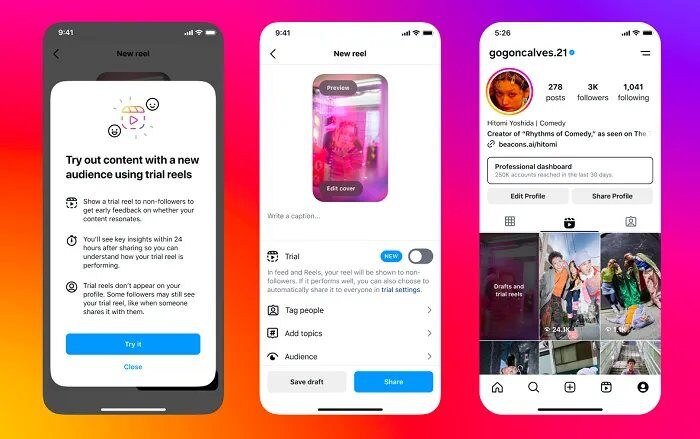
Instagram Trial Reels give eligible creators a more structured way to test content. Instead of immediately sharing a Reel with current followers, creators can first show it to non-followers and examine how a new audience responds.
Used correctly, this feature can help brands and creators test ideas without turning their main profile into a collection of uncontrolled experiments.
What Are Instagram Trial Reels?
A Trial Reel is an Instagram Reel initially distributed to people who do not follow the creator.
The feature was designed to help creators experiment with:
- New topics
- Different storytelling formats
- Alternative video styles
- Unfamiliar content categories
- New hooks
- Different audience segments
A Trial Reel generally does not appear to followers in the same way as an ordinary Reel during the initial testing stage. The creator can review its early performance and decide whether it deserves wider distribution.
Instagram has also provided options for automatically sharing successful trials more broadly based on performance. Exact availability and interface details can vary by account, location, and app version.
Why Trial Reels Matter
Creators often become trapped by their existing niche.
A fitness creator who wants to discuss nutrition may worry that followers only expect workout videos. A fashion brand may want to test behind-the-scenes production content but fear that it will disrupt a polished feed. A local business may not know whether educational or entertaining videos will attract more potential customers.
Trial Reels reduce some of that pressure by separating initial testing from normal follower distribution.
They can help answer questions such as:
- Will this topic attract people outside the current audience?
- Does this hook work with viewers who do not know the creator?
- Can a new format hold attention?
- Is the idea strong enough to publish more widely?
- Does the content attract relevant profile visits?
- Which version deserves paid promotion?
The feature does not guarantee accurate predictions, but it can provide additional evidence before a wider release.
Begin With a Clear Test Question
A Trial Reel should be designed to answer a specific question.
Weak test:
“Let’s see if this video works.”
Stronger tests:
- Does a before-and-after opening produce more views than a talking-head introduction?
- Will beginner tutorials attract more non-followers than advanced advice?
- Does showing the product in the first frame improve retention?
- Will a customer story generate more profile visits than a feature list?
- Does a shorter version produce a higher completion rate?
- Can a new content category attract the audience the brand wants?
A specific test question makes the results easier to interpret.
Without one, the creator may see that a Reel performed well but have no idea why.
Test One Major Variable at a Time
A common mistake is changing everything between two Reels.
One version may use a different topic, hook, presenter, video length, audio track, caption, and call to action. If it performs better, the creator cannot identify which change mattered.
For a cleaner comparison, keep most elements consistent and change one major variable.
Possible testing variables include:
- Hook
- First-frame visual
- Video length
- Presenter
- Voiceover versus talking head
- Tutorial versus story
- Caption
- Call to action
- Product benefit
- Audience segment
For example, a skincare brand could use the same demonstration with three openings:
- “Here is how to apply this serum correctly.”
- “This application mistake can waste your serum.”
- A close-up before-and-after result.
The main content remains similar, making the opening easier to evaluate.
Do Not Judge a Reel Only by Views
Views show how often a Reel began playing under Instagram’s current measurement system. They do not explain whether viewers stayed, understood the message, or cared about the account.
This distinction is particularly important when creators explore promotion or research where to buy Instagram views. Before selecting any third-party service, they should evaluate Instagram’s current rules, account security, delivery quality, retention claims, audience location, and whether the activity supports a measurable objective.
A larger view total cannot determine whether a Trial Reel found the correct audience.
Creators should examine the relationship between several metrics:
- Views
- Watch time
- Completion
- Replays
- Likes
- Comments
- Shares
- Saves
- Profile visits
- Follows
- Website actions
The strongest Trial Reel is the one that supports the intended goal, not necessarily the one with the largest public number.
Test Hooks With New Audiences
Current followers may recognize the creator, understand recurring jokes, and already know the product. Non-followers do not have that context.
This makes Trial Reels useful for testing whether a hook works without existing familiarity.
A strong non-follower hook should quickly establish:
- The subject
- The audience
- The problem
- The expected result
- The reason to continue
Compare these openings:
Weak:
“You asked for this, so here it is.”
A non-follower does not know who asked or what “this” means.
Stronger:
“Here are three ways small restaurants can film better food Reels without professional equipment.”
The second version explains the topic and identifies the audience immediately.
Try Topics Outside the Existing Niche
Creators sometimes avoid useful subjects because those subjects differ from what current followers usually see.
Trial Reels offer a way to explore adjacent categories.
A personal trainer could test:
- Affordable meal preparation
- Recovery routines
- Fitness equipment reviews
- Beginner gym confidence
- Time management for training
An ecommerce brand could test:
- Product education
- Customer mistakes
- Industry myths
- Behind-the-scenes production
- Founder stories
- Comparisons
- Maintenance tutorials
The most promising adjacent topic is usually connected to an existing audience problem. A completely unrelated subject may attract viewers who have little reason to explore the rest of the account.
Use Trial Reels for Audience Research
Performance data can reveal more than whether a single video deserves wider distribution.
A series of structured trials can show which audience problems produce the strongest response.
For example, a marketing agency may test Reels about:
- Low conversion rates
- Expensive advertising clicks
- Weak landing pages
- Poor lead quality
- Tracking errors
- Creative fatigue
If videos about tracking errors repeatedly generate saves and profile visits, the agency may have found a useful content cluster.
That insight can influence:
- Future Reels
- Blog articles
- Lead magnets
- Service pages
- Email campaigns
- Advertising messages
- Sales conversations
Trial Reels can therefore become part of wider market research.
Compare Creative Formats
The same idea can be presented in several ways.
Common Reel formats include:
- Talking head
- Voiceover
- Screen recording
- Product demonstration
- Before and after
- Customer story
- Text-led video
- Interview
- Behind the scenes
- Reaction
- List
- Myth versus fact
A software company might explain one feature through a screen recording, a founder-led explanation, and a customer scenario.
The subject stays consistent while the delivery changes.
This helps the team discover how the audience prefers to receive information.
Test Content Length Properly
Shorter Reels are not automatically better.
A six-second visual may be appropriate for a simple transformation. A tutorial may need 30 seconds or more to provide a useful answer.
When testing length, keep the central idea consistent.
Create:
- A short version showing the result
- A medium version explaining the main steps
- A longer version adding examples and context
Then compare more than completion rate.
The shortest video may be completed more often because it requires less time. The longer version may generate more saves, shares, profile visits, or sales.
The correct length is the shortest version that still delivers the intended value.
Avoid Publishing Identical Trials Repeatedly
Testing does not mean uploading the same Reel again and again with minor changes.
Near-identical content may create a poor experience if several versions eventually reach overlapping audiences. It can also make the testing process difficult to manage.
Variations should have a meaningful difference:
- A new opening angle
- A different audience problem
- A clearer demonstration
- A different presenter
- A revised structure
- A stronger example
Maintain a testing log so the team knows which versions were published and what each one was intended to measure.
Know When to Share a Trial More Broadly
A Trial Reel may deserve wider distribution when it:
- Holds attention
- Attracts relevant engagement
- Produces saves or shares
- Generates profile visits
- Fits the account’s content direction
- Supports a business objective
- Receives meaningful comments
- Performs well compared with similar trials
Do not create one universal threshold for every format.
A humorous Reel may need high reach and shares. A technical tutorial may be successful with fewer views but a strong save rate. A product Reel may be evaluated according to clicks or purchases.
The decision should reflect the purpose of the content.
Do Not Hide Weak Content From Followers Forever
Trial Reels should support experimentation, not become a way to avoid developing a clear content strategy.
If every new idea is permanently hidden from existing followers, the account may never evolve.
Current followers can provide useful feedback because they understand the creator’s history and expertise. Some experimental topics may also strengthen the relationship with them.
Use Trial Reels to identify promising ideas. Then develop the strongest ideas into content that can become part of the main profile.
Combine Trial Reels With Organic Content
A practical content system can contain three layers.
Core Content
Topics and formats already known to serve the existing audience.
Experimental Content
Trial Reels testing new hooks, topics, audiences, and formats.
Expansion Content
Successful experiments adapted for followers, collaborations, advertising, or a recurring series.
This approach balances consistency with exploration.
The brand keeps publishing recognizable content while maintaining a structured pipeline for discovering new opportunities.
Use Successful Trials in Paid Campaigns Carefully
A strong organic trial may become a candidate for advertising, but organic and paid distribution are not identical.
Paid campaigns may reach different audiences and operate under different conditions.
Before promoting a Reel, confirm:
- The message matches the campaign objective
- The call to action is clear
- The landing page continues the same promise
- Tracking is working
- Music and visual rights allow advertising
- Product claims are accurate
- The creator has granted the required usage rights
Test the Reel with a controlled budget before scaling.
Organic performance can guide creative selection, but it does not guarantee paid performance.
Build a Trial Reels Testing Log
A simple spreadsheet can include:
- Publication date
- Test question
- Topic
- Target audience
- Hook
- Format
- Video length
- Views
- Watch time
- Completion rate
- Likes
- Comments
- Saves
- Shares
- Profile visits
- Follows
- Website actions
- Decision
- Next test
The “next test” column turns data into action.
Examples:
- Use the same hook with another product.
- Shorten the introduction.
- Add a visible before-and-after result.
- Test the topic with a beginner audience.
- Turn the idea into a three-part series.
- Share the Reel with followers.
- Stop testing this audience angle.
A Simple Trial Reels Workflow
Use this process to build a repeatable system:
- Select one audience problem.
- Write one clear testing question.
- Create two or three meaningful variations.
- Change only one major variable where possible.
- Publish each Trial Reel under comparable conditions.
- Allow enough time to collect useful data.
- Compare goal-related metrics.
- Share the strongest version more widely.
- Record what was learned.
- Apply the finding to another topic.
The objective is not to predict every successful Reel. It is to reduce random decisions and make each experiment inform the next one.
Common Trial Reels Mistakes
Avoid:
- Testing without a clear question
- Changing too many variables
- Comparing unrelated topics
- Judging only by views
- Ignoring audience relevance
- Publishing misleading hooks
- Repeating nearly identical videos
- Scaling before checking conversion tracking
- Assuming one successful format will always work
- Abandoning an idea after one test
- Treating trial audiences as perfectly representative
- Making unsupported performance claims
Trial Reels provide data, but creators still need judgment.
Final Thoughts
Instagram Trial Reels give creators a practical environment for testing content with people outside their existing audience.
The feature is most useful when each trial has a clear purpose. Creators can compare hooks, formats, lengths, topics, and audience angles while keeping the broader strategy consistent.
The main advantage is not simply reaching non-followers. It is learning why certain content attracts attention and which ideas deserve further investment.
When the results are measured beyond views, Trial Reels can help turn experimentation into a reliable content-development process.