SFI Takes Center Stage at Crypto Valley Conference as Eddie Chong Highlights the Future of Trust, Liquidity, and Web4 Infrastructure
The Crypto Valley Conference (CVC) has long been regarded as one of Europe’s most influential gatherings for blockchain innovation, digital assets, and emerging financial technologies. Since launching in 2018, the event has attracted regulators, institutional investors, technology leaders, and pioneering blockchain projects, earning a reputation as a high-level forum that shapes discussions around stablecoins, tokenized assets, decentralized finance, and artificial intelligence.
Being selected to speak on the conference’s main stage is widely viewed as recognition of both a project’s industry impact and its leadership’s credibility. On May 28, 2026, one keynote in particular captured the attention of attendees across the blockchain and financial sectors.
Eddie Chong, Chairman and CEO of SFI Group, delivered a keynote that addressed two of the industry’s most pressing challenges: declining trust and insufficient liquidity. Rather than focusing on future possibilities alone, Chong presented what he described as an already operational Web4 ecosystem supported by active users, global payment infrastructure, real-world commercial applications, and regulatory compliance across multiple jurisdictions.
His presentation generated significant interest among investors, blockchain founders, payment providers, and regulatory professionals attending the event. Combined with new regulatory developments announced in Zug on the same day, the discussion reinforced a broader industry shift toward compliance-focused infrastructure and sustainable business models.
Addressing the Industry’s Fundamental Challenges
During his keynote, titled “Back to the Fundamentals: The Crisis of Trust – Why Liquidity is Dying and How We Must Evolve,” Chong argued that many of the challenges facing digital assets stem not from technology limitations but from a broader breakdown in confidence.
He pointed to several recurring issues across the industry:
- Tokenized real-world assets (RWAs) often struggle to maintain sufficient liquidity after launch.
- Stablecoins continue to face limitations in real-world consumer adoption.
- AI-driven applications are advancing rapidly but lack robust and compliant payment infrastructure.
According to Chong, fragmented regulations, uncertainty surrounding asset security, and the absence of trusted transaction frameworks have discouraged institutional participation and limited capital flows throughout the digital asset ecosystem.
As a result, liquidity remains constrained despite significant technological progress.
SFI’s Vision for a Web4 Economy
Chong described Web4 as a new phase of digital infrastructure where artificial intelligence evolves beyond a supporting tool and becomes an active participant in the economy.
In this emerging model, AI agents can potentially hold assets, initiate transactions, execute payments, and interact with digital services autonomously. However, much of today’s blockchain infrastructure remains designed primarily for human users.
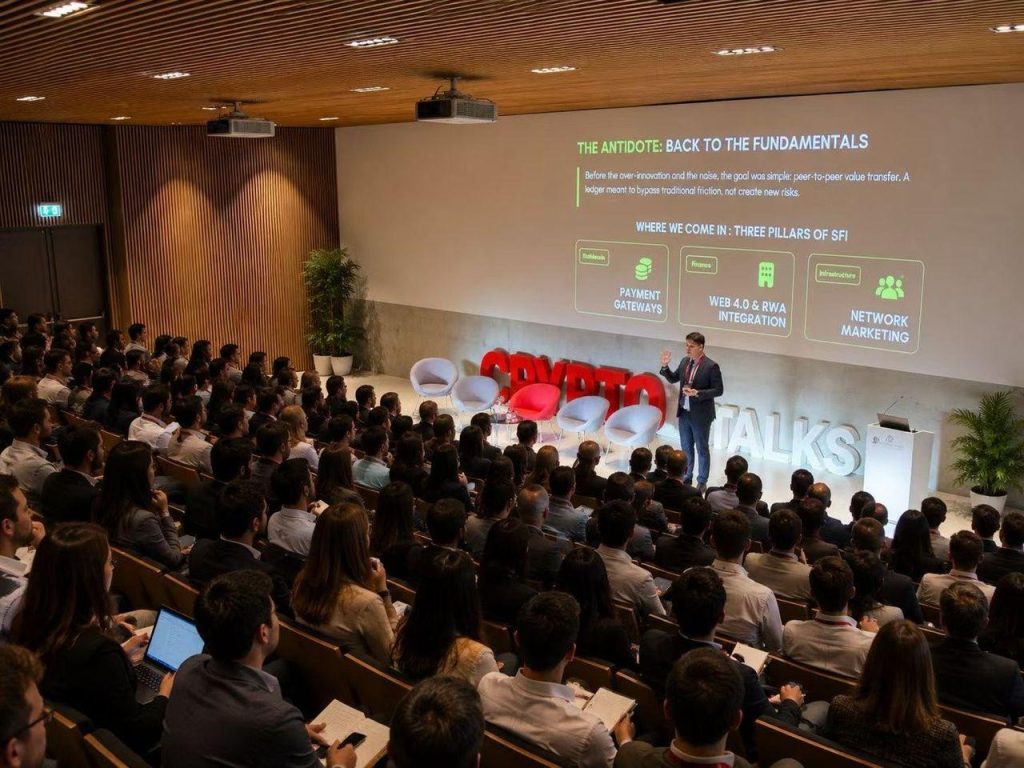
To address this gap, SFI has developed an ecosystem built around three core pillars:
- Stablecoins serving as transactional infrastructure.
- Real-world assets providing value and utility.
- AI technologies driving intelligent economic activity.
The ecosystem includes several integrated components:
Solulu Club
A community platform with more than 200,000 active users designed to support ecosystem engagement and liquidity.
Solulu Pay
A compliance-focused payment network operating across more than 100 countries, facilitating both fiat and digital asset transactions.
Caviar
A luxury-focused e-commerce platform featuring collaborations with premium brands such as Lamborghini and Fendi, providing real-world spending opportunities for stablecoin users.
COPX DAO
An AI-powered quantitative trading platform intended to generate additional ecosystem utility and value.
RWA Incubator & Exchange
A platform supporting the lifecycle of tokenized assets, including issuance, incubation, management, and market participation.
Throughout the presentation, Chong emphasized that sustainable liquidity cannot be created through marketing campaigns alone.
Instead, he argued that long-term liquidity is generated through genuine user activity, transparent transaction flows, compliant operations, and trusted asset backing.
His comments resonated with many attendees who have witnessed numerous projects struggle to transform ambitious concepts into sustainable businesses.
Strong Interest from Industry Participants
Following the keynote, Chong participated in a series of private meetings with institutional representatives, licensed custodians, payment companies, blockchain infrastructure providers, and AI-focused organizations.
Discussions reportedly centered on:
- Regulatory compliance strategies
- Cross-border payment solutions
- Institutional custody frameworks
- Stablecoin settlement infrastructure
- AI-powered payment integrations
Several organizations expressed interest in exploring future collaborations involving compliance services, payment infrastructure, and AI-enabled blockchain applications.
The engagement highlighted growing institutional demand for practical infrastructure solutions rather than purely speculative blockchain initiatives.
Exclusive Conference Interview
During a conference interview, Chong further expanded on his views regarding the industry’s current challenges and future direction.
Restoring Confidence in Digital Assets
When discussing liquidity issues within the RWA sector, Chong stressed that the underlying obstacle is trust rather than technology.
He noted that many projects have historically prioritized marketing narratives over operational execution, creating skepticism among both investors and institutions.
According to Chong, the path forward requires demonstrable business activity, recurring transactions, transparent governance, and a strong compliance foundation.
Only through these elements can the industry attract sustained institutional participation.
Europe’s Growing Role in RWA Development
Chong also highlighted Switzerland’s importance as a testing ground for institutional-grade blockchain innovation.
He suggested that increasingly clear regulatory frameworks will accelerate market maturation by separating infrastructure-focused organizations from projects that rely primarily on speculative narratives.
In his view, future industry leaders will be those capable of integrating compliant onboarding, stablecoin utility, asset appreciation mechanisms, and efficient RWA issuance within a unified ecosystem.
He positioned SFI’s ongoing development strategy as being aligned with this vision.
Regulatory Momentum Signals a New Chapter
The significance of the day extended beyond the keynote itself.
On the same afternoon, authorities in Zug introduced new policy guidance focused on tokenized assets and RWA markets. The framework addressed key areas including issuance standards, compliance requirements, circulation mechanisms, and cross-border settlement considerations.
As one of the invited industry representatives present during the announcement, Chong participated in discussions surrounding the evolving regulatory landscape.
He described the development as an important milestone not only for Switzerland but for the broader global digital asset sector.
The introduction of clearer standards reflects a growing emphasis on compliance, transparency, and institutional readiness across the blockchain industry.
Looking Ahead
The events of May 28, 2026, underscored a broader transition taking place across the digital asset market.
As the industry matures, attention is increasingly shifting away from speculative narratives and toward practical infrastructure capable of supporting real-world adoption.
Through its integrated approach combining stablecoin payments, tokenized assets, AI-driven technologies, and regulatory compliance, SFI aims to contribute to the next stage of blockchain development.
Moving forward, the company plans to continue expanding its focus on:
- Real-world stablecoin utilization
- Efficient RWA liquidity solutions
- AI-powered financial services
- Global compliance initiatives
Concluding his appearance at the conference, Eddie Chong summarized his perspective on the industry’s future:
“Compliance provides the foundation, and infrastructure creates the pathway forward. The next era of Web4 will be built by those who focus on delivering real systems that connect users, assets, and technology at scale.”
About SFI
SFI is building a Web4-focused ecosystem that combines digital payments, tokenized assets, artificial intelligence, and compliance-driven infrastructure. Through initiatives such as Solulu Pay, Solulu Club, Caviar, and COPX DAO, the company aims to create an interconnected framework supporting the next generation of digital economic activity.
Follow the SFI Ecosystem:
SFI: https://x.com/SFI_AI
SoluluPay: https://x.com/SoluluPay
Caviar: https://x.com/shopcaviar
COPX DAO: https://x.com/Copx_DAO
Company Name(公司名): SFI
Contact Person(联系人): Davil Lin
Email(邮箱):[email protected]
State(地区): Kuala Lumpur
Country(国家): Malaysia
Website(网站):https://solulu.club/