Planning Outdoor Lighting for Safer, More Welcoming Homes and Small Businesses in 2026

Key Takeaways
- Outdoor lighting works best when planned around safety, comfort, and property use.
- Choose fixtures based on purpose, including paths, entrances, security areas, and landscaping.
- Use layered lighting, proper aiming, and efficient controls to reduce glare and energy waste.
- Regular maintenance helps keep fixtures reliable and effective.
- A thoughtful lighting plan can improve safety, curb appeal, and outdoor enjoyment in 2026.
Outdoor lighting should do more than brighten a building after sunset. A thoughtful plan can make walking routes easier to follow, help visitors find entrances, support curb appeal, and improve the comfort of patios, storefronts, and service areas. For property owners seeking outdoor lighting services Hicksville, NY, Cain Borra Electric provides exterior, landscape, security, and pool-lighting electrical support for homes and businesses in Hicksville and across Nassau and Suffolk Counties. Its outdoor lighting service focuses on planning and installation, backed by the broader experience of a full-service residential and commercial electrical company. The goal is not to make every corner of a property equally bright. Overly powerful fixtures can produce glare, harsh shadows, light trespass, and unnecessary energy use. The best systems place useful light at the right height, direct it toward the task at hand, and use controls that match how the space is used.
Why Outdoor Lighting Deserves a Plan
Paths, stairs, driveways, gates, rear doors, parking spaces, and grade changes all deserve attention. A single fixture above a garage or entrance rarely solves every visibility issue. Planning by zones helps prevent dark gaps while avoiding the common mistake of adding a bright floodlight and hoping it covers everything.
Start With a Nighttime Property Walk
Before selecting fixtures or changing wiring, inspect the property after dark. Walk it as a guest, customer, delivery driver, or family member would. Take photographs from the sidewalk, driveway, and each main approach to the building.
- Mark dark areas near doors, gates, steps, paths, and driveways.
- Notice where landscaping, fences, parked vehicles, or branches block existing light.
- Look for glare shining into windows, neighboring yards, or nearby streets.
- Separate areas needing steady illumination from those that only need light when occupied.
- Identify fixture locations that can be reached safely for cleaning and maintenance.
Match Each Fixture to Its Job
Different locations call for different light patterns. Choosing fixtures by purpose makes the finished system more effective and less cluttered.
- Path lights: Guide people along walkways, garden edges, and low steps.
- Wall-mounted fixtures: Work well beside entry doors, garages, side doors, and service areas.
- Step lights: Make elevation changes easier to see without overwhelming the space.
- Floodlights: Cover broader areas when carefully aimed and properly shielded.
- Uplights and downlights: Add dimension to trees, signs, stonework, architectural features, and gathering areas.
- Pool and water-feature lighting:Requires properly rated equipment and careful electrical planning.
Build a Layered Lighting Plan
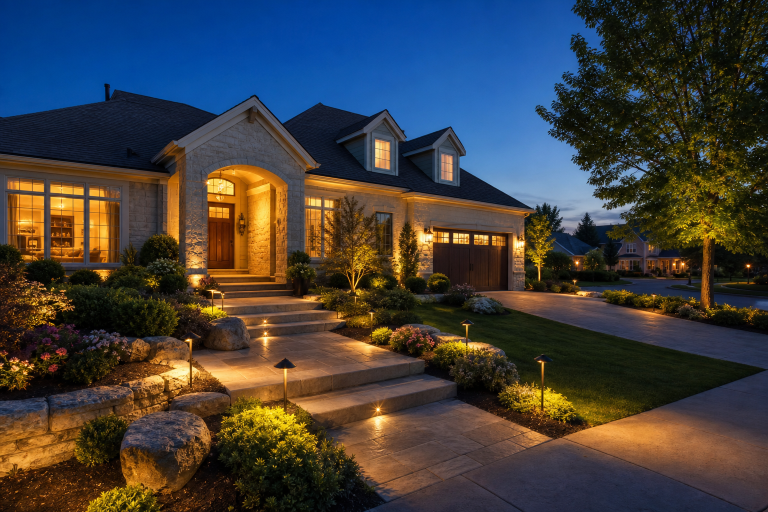
Layered lighting creates a more comfortable result than relying on one powerful fixture. Start with low-level base lighting for paths and entrances. Add task lighting where people need clearer visibility, such as on stairs, in cooking areas, at loading zones, or at rear doors. Then use a limited amount of accent lighting for landscaping, signs, or architectural details. Careful aiming matters as much as output. Shielded fixtures keep light directed downward or toward the intended surface.
Choose Color Temperature and Brightness Carefully
Warm-looking light often suits patios, gardens, seating areas, and residential facades because it feels relaxed and inviting. Neutral or somewhat cooler light may be useful at entrances, service doors, and commercial walkways where detail recognition matters. Still, brightness alone is not a measure of quality. Beam angle, mounting height, fixture shielding, surrounding surface colors, and the distance between fixtures all shape the final result.
Test one area before committing to a large installation when possible. A light that appears modest on a product label may feel intense when reflected off white siding, concrete, or a pale driveway.
Plan for Energy Use and Daily Controls
LED fixtures and practical controls can reduce unnecessary operating time without leaving important routes dark. Use timers or photocells for entrances and paths to ensure predictable operation from dusk to dawn. Use motion sensors for side yards, rear doors, and infrequently used service areas. Dimmers can lower decorative lighting later in the evening while preserving a welcoming appearance. Review settings as seasons change, since sunset times shift substantially through the year. The U.S. Department of Energy notes that exterior lighting systems can use controls such as timers, photosensors, dimmers, and occupancy sensors to match light output to actual needs better. Learn more about energy-efficient exterior lighting options before comparing fixtures and controls.
Keep Safety at the Center
Basic cleaning, lens replacement, and minor fixture adjustments may be manageable with the power off. However, new circuits, buried wiring, panel connections, pool lighting, damaged insulation, repeated breaker trips, water inside fixtures, or multiple failed lights call for qualified electrical help. Outdoor components should be rated for their environment, protected from moisture, and kept away from standing water, sharp edges, heat sources, and areas where yard tools are used.
Outdoor Lighting for Small Businesses
For shops, restaurants, offices, churches, and medical suites, start with customer entrances and accessible routes. Keep signs readable without creating glare for drivers. Use consistent lighting near sidewalks, parking areas, rear doors, and delivery zones, but separate customer-facing lighting from service and security lighting. A useful commercial plan also allows safe access to lenses, lamps, sensors, and controls for future maintenance.
A Practical Installation and Maintenance Checklist
- Inspect fixtures for cracks, rust, loose mounts, and water intrusion.
- Clean lenses and remove leaves, dirt, and insect buildup.
- Keep path lights upright, spaced consistently, and clear of overgrown plants.
- Test timers, sensors, photocells, dimmers, and switches.
- Look for exposed, damaged, or disturbed wiring after storms or landscaping work.
- Confirm that light is not shining into bedrooms, neighboring properties, or traffic lanes.
Common Outdoor Lighting Questions
How many outdoor lights does a property need?
Plan by zones rather than fixture count. The answer depends on walking routes, beam spread, fixture output, building layout, landscaping, and available ambient light.
Should outdoor lights stay on all night?
Entrances and low-level path lighting may benefit from longer schedules. Accent lighting can often be dimmed or switched off later, while motion activation may be sufficient for low-traffic areas.
Are motion sensors better than timers?
Neither is automatically better. Timers provide predictable operation, while motion sensors reduce runtime in spaces that do not need continuous lighting. Many properties benefit from using both.
When should a qualified electrician be called?
Call for professional help when the project requires a new circuit, underground cable, wiring through walls, panel work, pool connections, automation controls, or troubleshooting electrical problems.
Let the Property Guide the Plan
Effective outdoor lighting is not about installing the brightest fixtures or the most lights. It is about understanding how people move through the property, where visibility matters most, and how the system can operate safely over time. A nighttime walk, layered design, careful aiming, efficient controls, and seasonal maintenance can create an exterior that feels safer, calmer, and more welcoming throughout 2026.
Conclusion
A successful outdoor lighting system begins with understanding how a property is used after dark. By focusing on safety, comfort, energy efficiency, and proper fixture placement, homeowners and businesses can create spaces that are easier to navigate and more inviting. The best results come from balanced designs that avoid excessive brightness while providing reliable illumination where it matters most. With thoughtful planning, quality installation, efficient controls, and regular maintenance, outdoor lighting can enhance security, improve curb appeal, and add long-term value to a property throughout 2026 and beyond.